
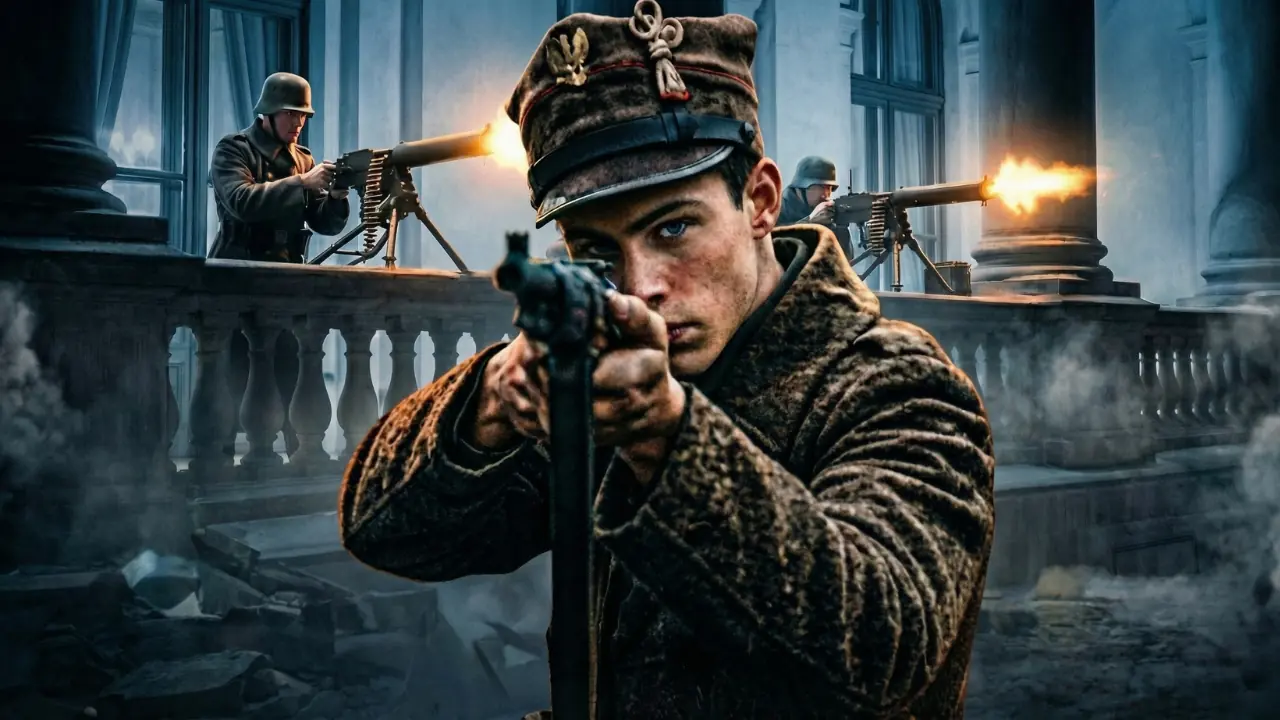
Screen Adaptation of an Official 1918 Insurgent Communiqué
Using the new possibilities of generative AI, we attempted a cinematic reconstruction of the first day of the Greater Poland Uprising by bringing to the screen the original “Communiqué of the Supreme People’s Council” on the events in Poznań on 27 December 1918.
A year after making “The Promise”, we returned to the Greater Poland Uprising. This time, instead of spanning more than a century of history, we focused on a single day — the beginning of the uprising and an account written immediately after the events.
The new capabilities of Google’s Nano Banana Pro, Kling O1 and Kling 2.6 gave us greater control over the consistency of characters, locations and details. Above all, however, they opened up broader possibilities for visual storytelling.
The screenplay and the concept behind every frame and shot were created by people; AI was used to visualise them. We used no archival footage or photographs in the film.
We deliberately styled the film’s visual language after a 1930s newsreel. Black-and-white imagery in a 4:3 aspect ratio, heavy grain, subtle frame jitter, flicker, dust, scratches, soft focus, limited tonal range and subtle vignetting create the impression of authentic archival footage.
The result is an original, fully staged screen adaptation based on a historical source. It shows how AI film production can retain full creative control while achieving a scale of staging impossible in a traditional production with a comparable budget. To the best of our knowledge, it is the first film adaptation of this specific “Communiqué of the Supreme People’s Council” and one of the few productions focused exclusively on the events of 27 December 1918 in Poznań.
Work on the film began with analysis of the source text, revision, translation and prompting, supported by ChatGPT and Gemini Pro agents. Frames were created in Nano Banana Pro and Kling O1, while shots were generated in Kling O1 and Kling 2.6. ElevenLabs provided the voices and soundscape, Sync.so handled lip sync, and mUpscaler AI was used to enhance image quality. Editing and post-production were completed in Final Cut Pro using CineStudio and DesignStudio by MotionVFX — the film’s technology partner and a Polish plugin developer that became part of Apple in 2026.
The film was made as the third episode of The Fyrtel Chronicles — an original series combining documentary, fiction and modern technology. Each episode tells a standalone story set in a different fyrtel: a district, town or region.