AI Commercial Production. Less Is More
For our website, we created three short films communicating our offer. They autoplay, so they need to be lightweight — and therefore short. But does a few seconds of an AI commercial really mean less production work?
The goal was to advertise two variants of our offer. PREMIUM in a Box is a production package at a competitive market price, with a tightly defined scope. If a client needs more, that scope can be expanded and scaled.
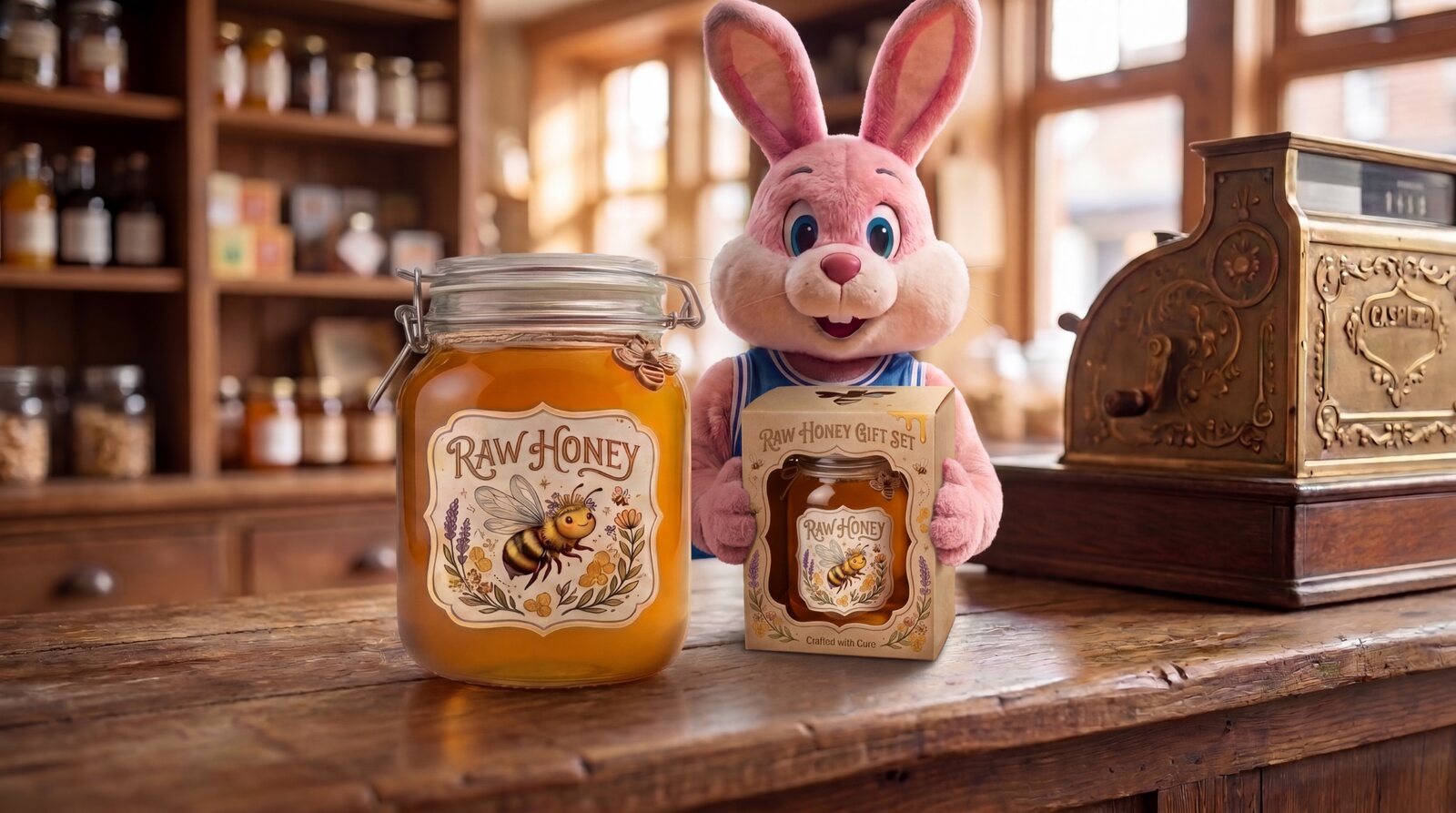
Advertising, however, does not have to describe the physical features of a product. It can often work better when it shows the emotions connected with it. That is why we built our story around desire. A hungry bear sees a large jar of artisan honey and simply starts wanting it. The choice of honey was not accidental. Our production is artisanal too — hands-on rather than fully automated. Instead of the whole jar, the bear gets a smaller portion to try in an elegant box.
For this AI commercial production, the film is only one part of the communication. From there, the offer continues in the website copy, guiding the viewer through the AIDA model. The sequence ends with a three-second shot of the bear looking at the box and speaking. It is a filmic close to the CTA, inviting a conversation about the production details.
The second variant, PREMIUM at Scale, continues the same story. The bunny puts the box aside and gives the bear the whole large jar of artisan honey.
Altogether, we produced 13 seconds of material: 7 seconds for PREMIUM in a Box, 3 seconds for the CTA, and 3 seconds for PREMIUM at Scale.
To produce those 13 seconds:
- Refined the objective and subject of the communication.
- Structured the whole sequence around the AIDA model.
- Wrote a short script and shot breakdown.
- Checked that the story fit the rest of the website communication.
- Prepared character references. We already had the bunny; four new reference frames were created for the bear.
- Prepared references for both product variants: honey in a box and a large jar.
- Created a consistent shop location — counter, background and reverse angle.
- Created a short four-frame storyboard.
- Prepared the prompts and generated the shots in Seedance 2.5 (see a prompt example).
- Selected and refined generations, maintaining continuity across the characters, location and props — visual metaphors for the two variants of the offer.
The videos appear in the header and footer of the website, underneath a layer of text. They are short and silent, so editing, sound design and post-production were not required. Even so, the whole process took several hours.
The point is not the time needed to generate shots, which many AI tutorials present as if it were the production time of the entire film. We mean actual work — from the idea to publishing the material on the website.
Does less mean more in the production of an ad like this? Yes, if we care about detail. Nothing in the frame should be accidental. A character, a prop, even the wording on a jar — every element has a function.
This is how we approach AI film production. Generative AI is a tool, not a director. It can speed up execution, but the idea and the entire creative process still develop at a human pace. Screen time is therefore neither the only nor the most important measure of the workload.